
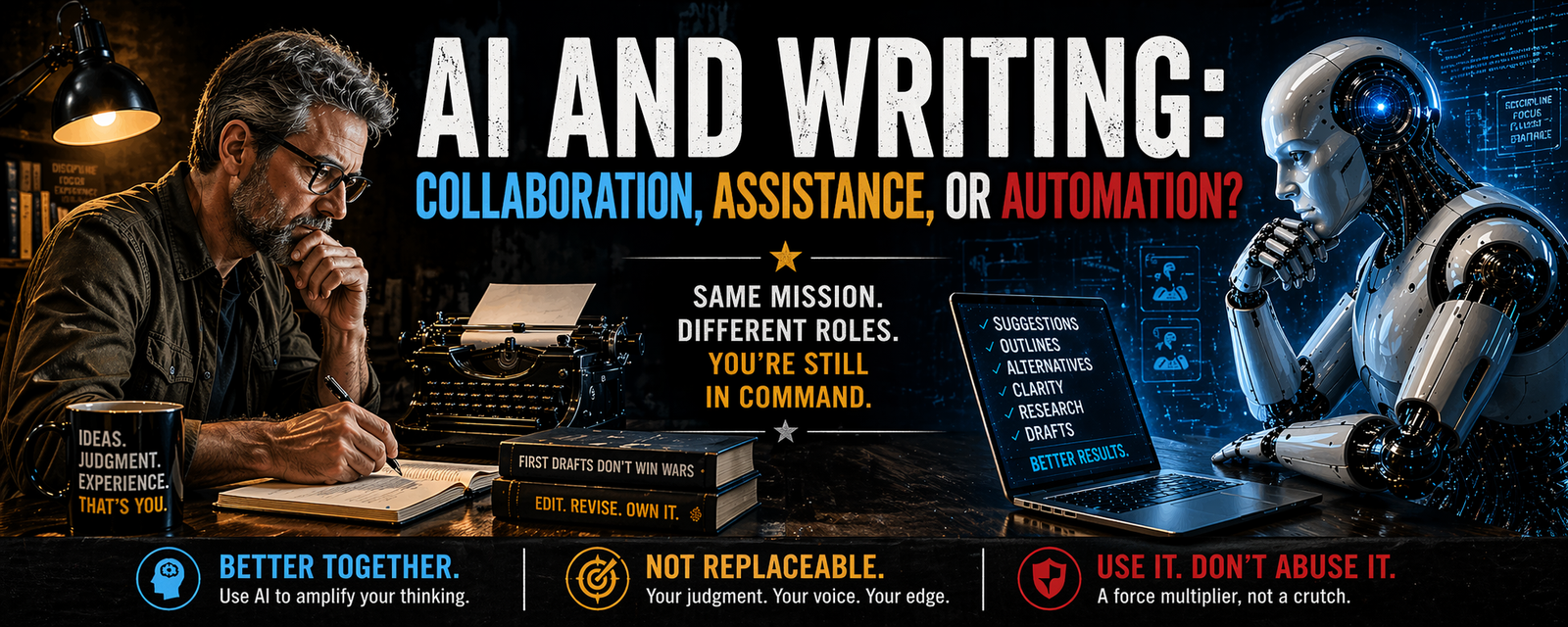
Let’s quit lumping everything under the phrase “AI writing” like it all means the same thing. It doesn’t.
There is a massive difference between using AI to brainstorm ideas, using it to tighten your draft, using it to turn your outline into prose, and punching in a half-baked prompt so the machine can vomit out an article while you pretend you wrote it.
Those are not the same activity. They are not the same level of authorship. They are not the same level of honesty.
And because people have the attention span of caffeinated squirrels in a fireworks factory, here’s the short version first.
The Quick Version
There are six main types of AI writing.
1. AI-Only Generation
You type a prompt. The AI writes the whole thing. You may clean up a few lines and slap your name on it. This is not collaboration. This is automation.
2. AI Assistance
You do the writing. AI helps with brainstorming, outlining, structure, revision, clarity, checking continuity, or punching holes in weak ideas. The human is still the author.
3. Guided Drafting
You provide the ideas, structure, bullet points, examples, and direction. The AI turns that into prose. This is useful, but it lives in the gray zone between help and ghostwriting.
4. Iterative Collaboration
You and the AI go back and forth. It proposes, you reject, redirect, rewrite, combine, and shape. This is the closest thing to real collaboration, because the human is still steering the vehicle instead of riding in the trunk.
5. AI Ghostwriting
You know what you want to say, but you want the AI to do most or all of the sentence-level writing. That is not really collaboration. It is outsourced drafting with a silicon intern.
6. Prompt-and-Paste Garbage
You give the AI a vague prompt, get a finished piece, barely touch it, and call yourself a writer. No. That is vending machine behavior, not authorship.
That is the map.
Now let’s talk about what actually matters.
The Only Question That Matters
Whenever somebody says, “I used AI to write this,” the response should not be impressed nodding and tech-bro fog.
It should be four questions:
- Who came up with the ideas?
- Who built the structure?
- Who wrote the prose?
- Who made the final creative decisions?
That tells you what really happened.
Because “AI-assisted” can mean anything from “I used it to test my outline” to “I let the machine do all the work and changed two adjectives.” Those are not remotely the same thing, no matter how much people want to blur the line.
1. AI-Only Generation
This is the simplest category.
You type in a prompt. The AI does the heavy lifting. You get a full article, story, email, blog post, or whatever else. Maybe you tweak the intro. Maybe you delete the most obvious robotic nonsense. Maybe you do nothing at all.
This is not collaboration. This is generation.
It may be fast. It may even be usable for certain low-stakes jobs. But let’s not confuse output with authorship. Owning a nail gun does not make you a carpenter, and pushing a button does not make you a writer.
AI-only generation is fine for summaries, throwaway copy, rough placeholders, and a lot of corporate sludge the world probably did not need in the first place. It is not the same as real writing.
2. AI Assistance
This is where AI starts becoming legitimately useful for serious people.
In this model, the AI helps with the process without replacing the author. It helps you brainstorm, outline, test arguments, identify repetition, sharpen phrasing, catch continuity issues, or point out where your structure is sagging like an old cot in a bad barracks.
The human still owns the piece. The human still does the thinking that matters. The human still decides what belongs, what gets cut, what tone fits, and what the final language should feel like.
This is the best category for writers who actually care about craft.
Used this way, AI is not your replacement. It is a force multiplier. It lets you move faster, test more options, and waste less time wandering around in your own mental fog.
That is real value.
3. Guided Drafting
This is where the water gets muddy.
In guided drafting, the human brings the material. The thesis. The outline. The examples. The direction. The section goals. The argument. The emotional beats. Then the AI turns that into paragraphs and transitions.
This can be efficient as hell. It can also create a fake sense of authorship if the human starts pretending that providing bullet points is the same thing as writing.
Sometimes guided drafting is honest and practical. Sometimes it is just ghostwriting in a nice suit.
The dividing line is simple: how much of the actual language and shaping still comes from the human?
If the human is deeply involved, rewriting heavily, making hard choices, and imposing real voice, then this is advanced assistance. If the human is mostly approving what comes back, then it is drifting toward ghostwriting.
That distinction matters, whether people like it or not.
4. Iterative Collaboration
This is the category that actually deserves the word collaboration.
Here the human and AI work in cycles. The human asks for options, the AI gives them. The human rejects most of them, rewrites the useful parts, changes direction, pushes deeper, sharpens the tone, and sends it back through again. The process is interactive.
This can be incredibly effective.
It is also dangerous if the writer gets lazy.
Because real collaboration still requires a mind in charge. The AI can offer options, patterns, phrasing, structures, and alternate routes. But it does not know what matters most to you unless you do. If you surrender judgment, you are no longer collaborating. You are drifting.
Used well, iterative collaboration can help a strong writer move faster without losing control. Used badly, it turns into endless loops of competent mediocrity.
5. AI Ghostwriting
Let’s call this what it is, because dancing around it is stupid.
In this model, the human has the message, the rough ideas, maybe the structure, but wants the AI to do most of the actual prose. The machine becomes the ghostwriter.
There are cases where this is practical. There are cases where it is efficient. There are even cases where it is defensible. But it is not the same thing as collaboration, and calling it collaboration often sounds like somebody trying to make outsourcing feel noble.
If the machine is doing most of the sentence-level composition, then the machine is ghosting the prose.
You may still own the intellectual direction. You may still be responsible for the outcome. But let’s not play word games. If someone else, biological or digital, is doing most of the writing, that is ghostwriting.
6. Prompt-and-Paste Garbage
This deserves its own category because the internet is flooded with it.
This is when someone types in a vague prompt like “write me a blog post on leadership in uncertain times,” gets back a polished blob of generic sludge, makes three cosmetic edits, and then presents it like they forged it in the fires of hard-won human insight.
No.
That is not collaboration. That is not craftsmanship. That is not even respectable laziness. That is just process theater.
You do not become a writer because a machine handed you paragraphs. You become a writer by developing judgment, voice, structure, discipline, and taste. The machine can help with those things. It cannot magically inject them into somebody who never bothered to build them.
A bad writer with AI is still a bad writer. He just produces more bad writing, faster and at industrial scale.
Why These Distinctions Matter
Some people treat these differences like nitpicking. They are not.
They go straight to the heart of:
- authorship
- transparency
- skill development
- voice
- reader trust
- quality control
A writer who uses AI to pressure-test an outline is not doing the same thing as someone who lets AI spit out an entire piece and then hits publish. Both may say they “used AI,” but that phrase is almost useless unless you know how it was used.
And that matters more now than ever, because AI is making it easy to produce clean, competent, completely forgettable prose in bulk. Once everyone can do that, basic output stops being impressive.
Judgment matters more. Voice matters more. Taste matters more. Structure matters more. Original thought matters more.
In other words, AI does not kill craft. It exposes who never had any.
The Luddite Problem
Now let’s deal with the other camp, the people who react to AI like it is a demon, a fraud, a cultural apocalypse, and possibly a communist plot.
These are the modern Luddites. They reject AI outright, usually with a moral pose attached, as if refusing to learn a new tool makes them noble instead of obsolete.
News flash: AI is not going away.
You do not have to worship it. You should not trust it blindly. You absolutely should not hand it the keys to your brain and then wander off to admire your principles. But pretending it can be ignored out of existence is childish.
History is full of people who sneered at new tools right before those tools rewrote the battlefield, the workplace, or the market. Sometimes the skeptics were right about the dangers. They were still crushed if they refused to adapt.
That is how arms races work.
The people who use new tools most effectively tend to win. The people who deny the tools matter tend to become cautionary tales, trivia questions, or footnotes.
Writing will be no different.
The winners will not be the blind AI evangelists who think the machine is magic. Those people are usually one software update away from becoming annoying cautionary posters. The winners will also not be the purists standing in the corner ranting about authenticity while the ground shifts beneath them.
The winners will be the professionals.
The ones who learn where AI helps.
The ones who learn where it lies.
The ones who know when to use it, when to ignore it, and when to beat it back into its crate because it is offering polished nonsense.
That is the future.
Not purity. Not denial. Not hype. Competence.
AI Is a Weapon, Not a Religion
This is where too many conversations go stupid.
AI is not a moral identity. It is not a belief system. It is not a replacement for talent. It is a tool, and a powerful one.
Like any powerful tool, it can be used well, badly, carelessly, creatively, dishonestly, strategically, or incompetently.
A rifle in good hands is a force multiplier. In bad hands, it is just louder stupidity. Same principle.
Writers who understand AI as a tool will learn to move faster, test more ideas, revise harder, and scale what already works. Writers who depend on AI to replace thinking will produce clean-looking mediocrity and wonder why nobody remembers their work.
The machine is not the differentiator.
The human is.
So What Counts as Real Collaboration?
Here is the clean answer.
AI collaboration is real when the human remains the source of:
- intent
- judgment
- direction
- selection
- rewriting
- standards
- final responsibility
If the AI is supporting those things, that is collaboration or assistance.
If the AI is replacing those things, that is automation or ghostwriting.
That is the line.
Not perfect, not legalistic, but honest.
Conclusion
AI and writing are not one thing. They are a spectrum.
At one end, AI generates content while the human rubber-stamps it. That is automation. In the middle, AI helps brainstorm, structure, test, revise, and draft under human direction. That is assistance or collaboration. At the far end, AI does most of the sentence-level work while the human supplies general intent. That is ghostwriting, whether people want to admit it or not.
The real issue is not whether AI touched the work.
The real issue is who did the thinking, who did the shaping, and who is still in command.
Because AI is not going away. The people who learn to use it intelligently will outperform the people who fear it, ignore it, or worship it. That is how every serious tool race works. The deniers will become footnotes. The zealots will become punchlines. The professionals will adapt and win.
And in the long run, that is how it should be.
If you want, I can do one more pass and make it even tighter for blog publication, with stronger subheads and a sharper opening/closing punch.